
ccording to the National Reconstruction Authority, reconstruction funds have yet to be distributed to 2,589 households across 33 districts.
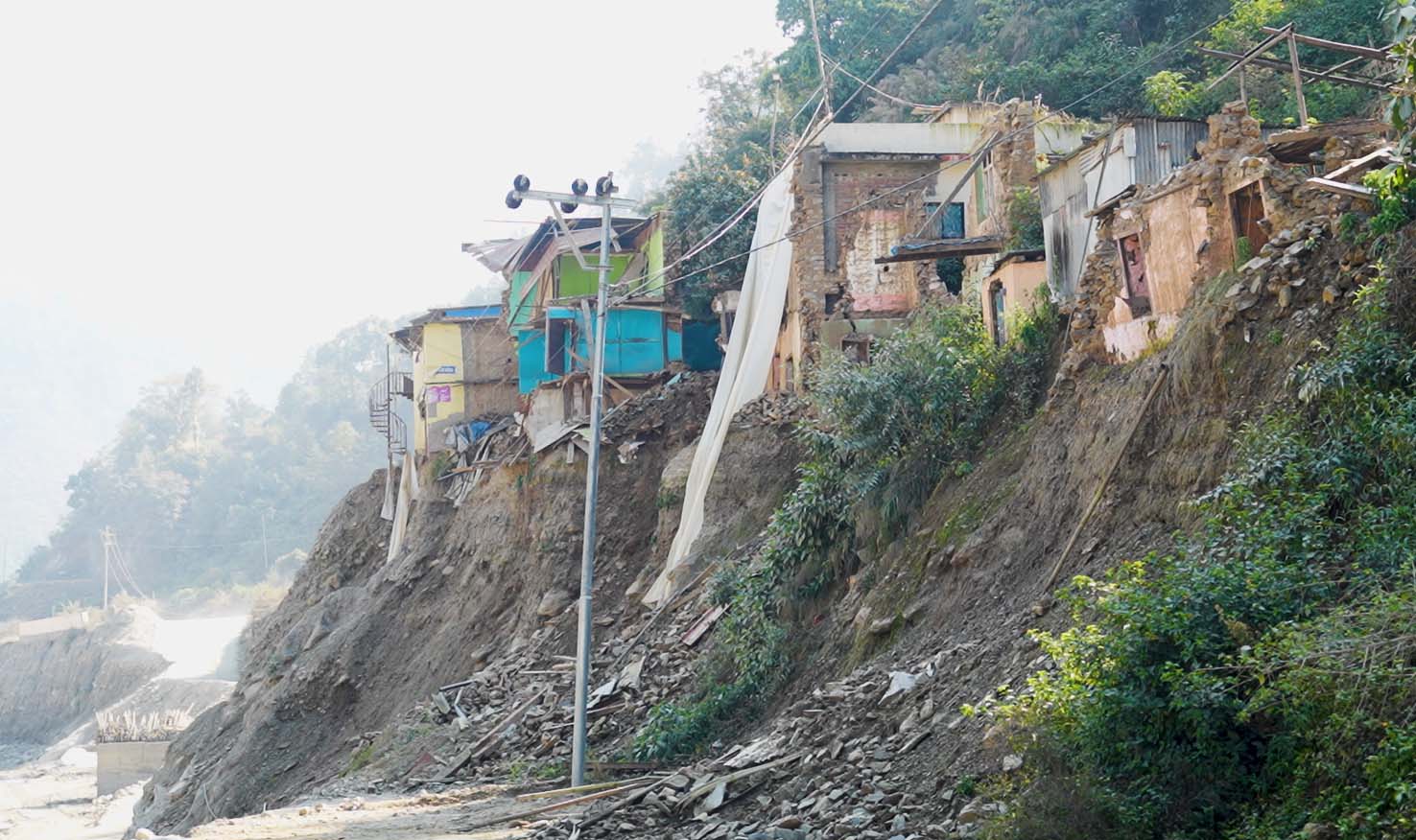
In Kaldhunga Bazaar, situated along the banks of the Roshi River in Roshi Rural Municipality, Kavrepalanchok, only the skeletal remains of walls stand where houses were partially swept away by floods. Although the floods of September 28, 2024, washed away half of these structures, the remaining sections still cling precariously to the edge of the riverbank. 
These houses are clearly visible to travelers commuting to and from Kathmandu via the BP Highway, which the September floods had turned into a wasteland. Since the land beneath the washed-away sections has dropped significantly into the riverbed, the ruins appear as if they are hanging off a cliff.
Jeevan Shrestha is one of the owners of the 11 houses located here. A teacher by profession, his eyes fixate on his half-collapsed home, dangling like it is caught on a precipice, every time he travels this route. “The house I built with such hardship remains only in my memories now,” he says.
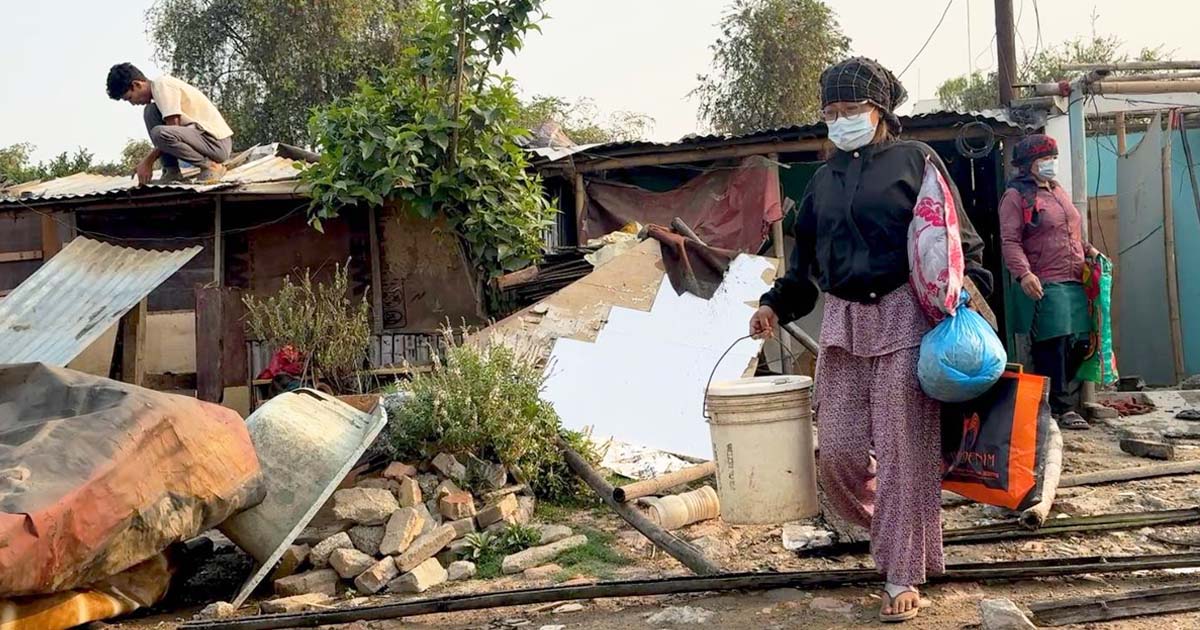
After the flood destroyed his home, he moved into a temporary hut built on a patch of farmland some distance from the market. However, a windstorm on March 16, 2026, blew that shelter away, forcing him to build a second one.
Chyangba Rani Tamang is another resident of this settlement. After the Roshi flood demolished her house, she rented land in nearby Mangaltar to build a hut. She has already endured one rainy season and two winters in this shelter. As another monsoon approaches, she is consumed by the worry of having to spend it in the same shack she built 20 months ago.
Jeevan and Chyangba Rani lament that they are still forced to live in huts because they have yet to receive the reconstruction funds promised by the government. They are not alone. According to the National Reconstruction Authority, there are 2,589 households across 33 districts waiting for housing grants.
Although the authority has verified them as beneficiaries, the funds remain undistributed due to a lack of effective coordination between local governments and the federal administration. The authority alleges that local levels have failed to even request the first installment after signing agreements with beneficiaries and approving new house designs.
“It is not the authority's job to sign agreements with beneficiaries. We conduct the Damage and Needs Assessment (DDA) and hand it over to the local levels. They must request the budget after the agreements are made and the authority sends the funds accordingly,” says Ram Bahadur KC, Deputy Secretary of the authority.
According to him, reconstruction work has stalled because of delays at the municipal level. “The authority does not lack the budget for reconstruction,” he stated. “There are 3 billion rupees for reconstruction sitting in the account, yet it remains unspent.”
Rule 6 of the Disaster-Sensitive Social Security and Relief Distribution Standards, 2081, contains provisions regarding the mobilization of recovery relief. It specifies that targeted households identified through detailed Damage and Needs Assessments (DNA) shall be provided with minimum arrangements for temporary housing, food security and cash assistance.
Rule 6 (c) states that 50,000 rupees shall be provided for the immediate construction of temporary housing for households whose homes were completely destroyed by a disaster or for those who must be relocated to avoid potential danger. Following this provision, most families who suffered total loss have already received 50,000 rupees in two installments of 25,000 rupees each to build temporary shelters.
According to the standards, homeowners requiring retrofitting receive 100,000 rupees. The amount provided for houses requiring full reconstruction varies based on the geographical region.
The standards mandate providing 500,000 rupees to those in mountainous districts, 400,000 rupees to those in hilly districts including the Kathmandu Valley, and 300,000 rupees to affected residents in the Terai and Inner Madhesh districts. Deputy Secretary Ram Bahadur stated that according to these guidelines, the first installment will be dispatched to beneficiaries as soon as the local level signs the agreement.
Although the list submitted by local levels reported damage to 6,254 houses nationwide during the floods and landslides of September 2024, the authority has identified 3,319 beneficiaries. According to this, 1,890 households across 33 districts require complete reconstruction of their homes.
Additionally, there are 367 houses requiring special retrofitting and 332 houses requiring general retrofitting. The authority’s data indicates that 730 houses require no further assistance. Based on these figures, there are 2,589 households eligible to receive grants.
According to the preliminary damage and loss assessment report released by the National Disaster Risk Reduction and Management Authority on November 7, 2024, immediately following the September floods, 5,996 houses were completely destroyed. Furthermore, 13,049 houses sustained partial damage.
The discrepancy between the number of damaged houses and the number of beneficiaries arises because a beneficiary must not have habitable housing elsewhere, must possess a citizenship certificate, must provide a land ownership certificate or proof of occupancy, and only one person per family recommended by the respective ward can be designated as a beneficiary.
Grant agreements commence in some locations
The problems faced by those affected by the floods and landslides of September 2024 have not been resolved even after 20 months. “Living in a shack, the dew drips in during the cold. In the summer, it gets very hot,” said Chyangba Rani from Roshi. “Staying in a hut is very difficult. How can it ever be like having your own home?”
She complains that she has only heard talk of the government building houses but no work has been done. She said, “They say money will come from the government but who knows. It hasn’t arrived yet.” She is also frustrated that while they came and measured her destroyed house, the money to rebuild it is still missing.
Dinesh Lama, Chairperson of Roshi Rural Municipality, stated that the grants were delayed for various reasons but agreements have finally started. This was confirmed by Jeevan, who said, “We have just received information to sign the agreement for reconstruction.”
Similarly, Ganesh Kumar Khadka, Executive Officer of Ilam Municipality, stated that agreements are currently being signed with identified beneficiaries.
He explained that delays occurred because some did not build structures even after receiving the first installment for temporary housing and because the Reconstruction Authority listed some houses for retrofitting only, despite the municipality recommending full reconstruction. “We have signed agreements with those we identified as beneficiaries,” he said. “Their reconstruction installments are now in the process of being disbursed.”
However, Milan Silwal, spokesperson for Godawari Municipality in Lalitpur, alleged that the process of building private housing has not moved forward because the authority has shown no interest. “The idea of building permanent housing has just been rumors. Because the Reconstruction Authority hasn’t shown interest, the matter of building private homes hasn’t been able to progress at all,” he said. “The authority hasn’t even sent a letter.”
Not just shelter, an entire lifestyle was destroyed
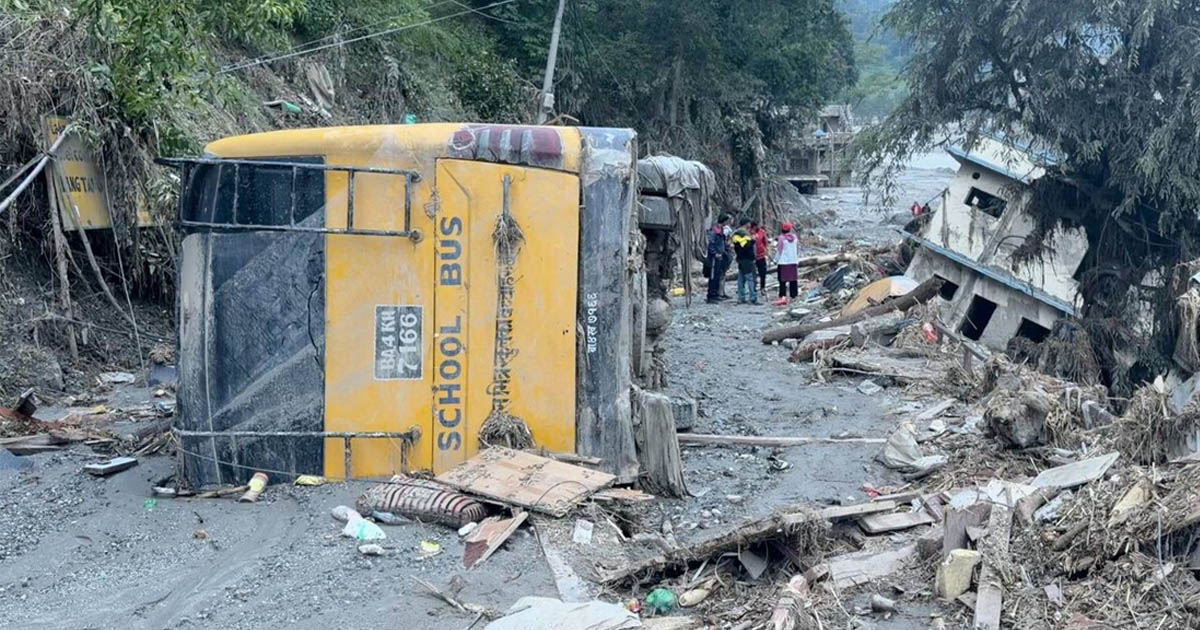
Those displaced by the floods, like Jeevan and Chyangba Rani, have been unable to return to their original homes, causing a complete disruption of their way of life. “We have not yet been able to resettle those displaced after the floods,” says Jayaram Khatri, Ward Chair of Panauti Municipality-12 in Kavre. “Flood victims are still waiting for reconstruction to begin.” In Panauti alone, the September floods damaged 280 houses.
After the flood swept away her two-and-a-half-story house, Sushila Basnet of Panauti Municipality-12 moved to Banepa, where she now lives in a rented room. “There is no shelter in the village and no money to build a house,” she said. “When you lack a place to stay and a meal to eat, there is no alternative but to leave the village. Now, I am working in a hotel to support my son’s education.”
Having lost her husband just a few months before the flood, she arrived in Banepa with her infant son in search of refuge. Sushila notes that while she heard the government would rebuild destroyed homes, nothing has happened so far. In Panauti, the process of signing beneficiary agreements has not yet begun.
Those affected by the floods long to return to their original homes. “We want to be resettled in the very place from which we were displaced,” says Jeevan from Roshi. “Right now, we are just struggling.”
Please adhere to our republishing policy if you'd like to republish this story. You can find the guidelines here.
Comments